2025/10/30
First expressions of Cairo
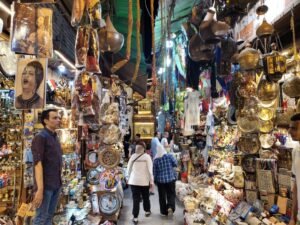
When you do the basic research about Cairo, then you will probably learn that foreigners will have problems with the simple task of “crossing the street”. In Cairo, there are almost no pedestrian crossings and the traffic is extremely busy and hectic. You could even say it is chaotic. In the same part of the street there can be pedestrians, motorcycles and cars… and the car drivers are talking with phone or checking messages on their phones half of the time.
So the first level of crossing the street is to “learn the flow” of the street and to try to “shadow the locals”. Or if you are sufficiently rich, then just hire a guide for the whole day who will always walk with you and help with everything (including crossing the street).
So in this mad traffic everybody is just honking all the time and it can be quite scary and annoying when coming directly from Japan where honking is extremely rare and the whole traffic situation is at least 10x more organized.
- What I would recommend here is just keep walking next to the traffic for an hour or 2. Eventually you will start getting used to the honking and just filter it out.
- But if you are over 60 years old and maybe not able to walk fast any more, then you might want to actually avoid walking in Cairo traffic at all. Just take point-to-point Uber at each leg of your daily plan (or hire a driver for a day). Especially with a bigger group the driver will not be a big expense at all.
My second experience was with Metro. I planned to learn using it as one of the first things… but the metro station Nasser (as shown on Google Map) was to my surprise completely closed. On the Ramses street there are stations Nasser and Orabi, but they were closed. So I assume they are part of the line which is maybe not open yet…
- Quite a bit later I found that there is another entrance to Nasser station on the 26th July St, which for some reason is not shown on Google map… and which was open. I was very surprised that you can’t rely on Google map for such a basic information. Maybe it just shows that all the tourists are using Uber only and no-one is actually trying to use Metro at all.
The Egyptian Museum in Cairo
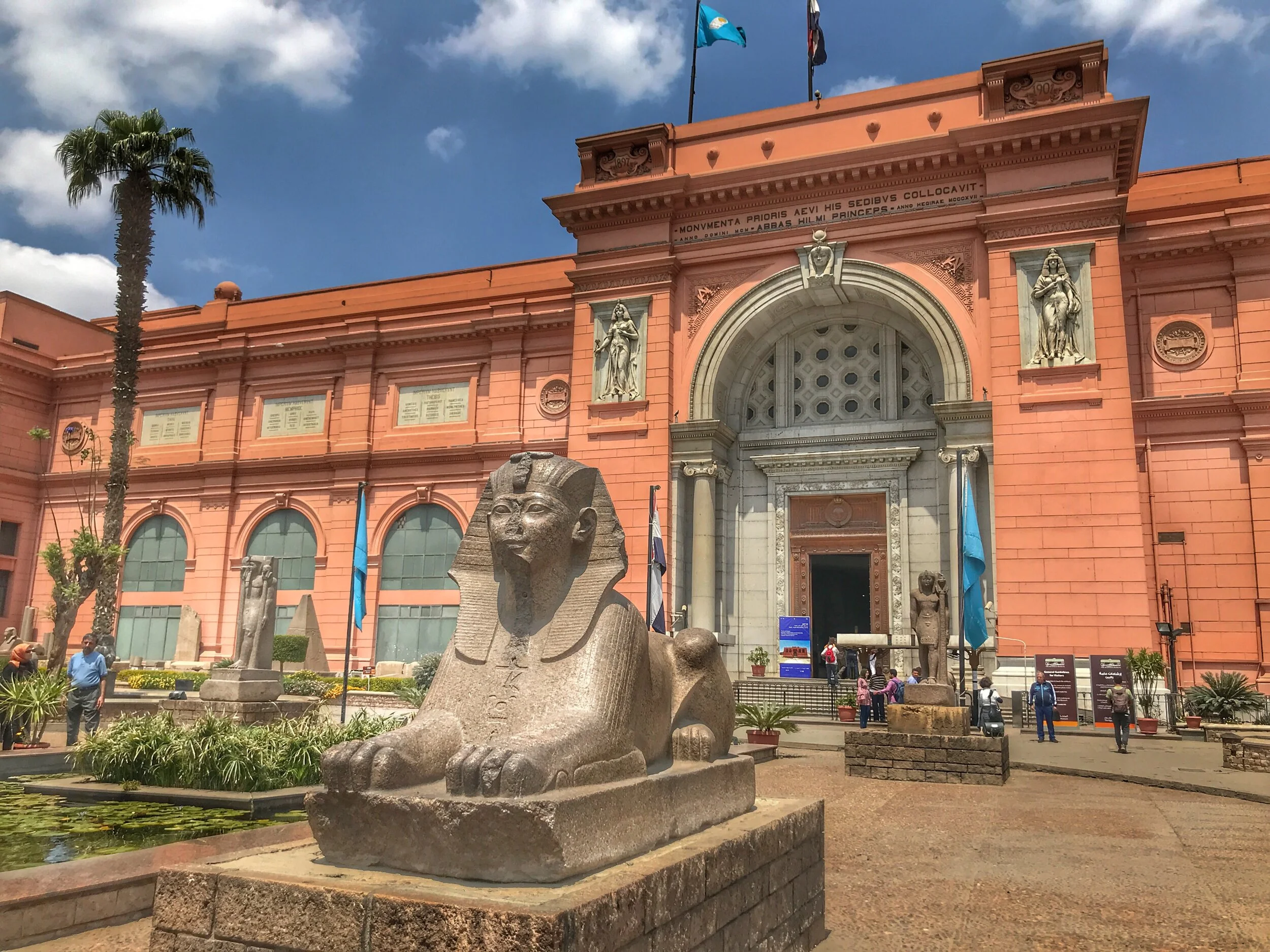
The Egyptian Museum in Cairo happened to be a walking distance from my hotel, so there I went. On the way learning the art of crossing the street as a pedestrian in Cairo.
The museum entrance is a security check next to the driveway for the cars, so it was actually easy to miss this as being part of the security check for cars. After that there was another security check to enter the museum territory and then a 3rd security check to enter the museum with the ticket.
The museum itself… is probably a better experience with interesting tour guide. Now I was told that every item has a label, so no need to pay for the guide… but some guides I saw very really into their stuff and had a very great energy around them. The labels I was reading very quite small (I think some even printed with typewriter like 100 years ago) and only gave the basic facts. Unless one has an active interest in Egyptology and can weave the story in their heads, then these facts can be quite boring. Now, I had some interest and had listened to a few Great Lecture series about the history of Egypt… but I did it already over 1.5 years ago… and my memory was totally not active about all the kings and periods… At least I had the basic understanding of the main periods of the pharaonic Egypt’s history. Otherwise it would have been even more difficult to find meaning.
- just to note that I went to the museum almost straight after my 20-hour trip to Cairo… and then after walking in hot Cairo streets for an hour or two… so I was totally not in a top condition to enjoy the Egyptology collections🙂
The museum was surprisingly big, there were many corners and separate rooms where there were loads and loads of “items”. I felt already after 1st hour that my ability to enjoy Egyptian artefacts is completely satisfied. There can be totally big statues, or totally golden ornaments, or massive sarcophags, or even mummies… And seemingly nothing excited me much any more… I had seen them all in vast quantities seemingly filling spaces from floor to ceiling…
What really excited me:
- I saw the amazing actual “sacrificial bowl”, which is considered to be maybe from much earlier period (earlier civilization) than the Egyptian pharaohs.
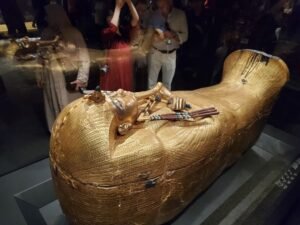
- Some sarcophagy were really big (bigger than the human size). It turned out that at least some of the sarcophags had a smaller inner sarcophage and a bigger outer sarcophage. Kind of like a russian matrjoshka. I had maybe missed this from the lectures, but from real examples this was really visible. Kind of made me wonder that what was the reason for such big after-death statues? Is it related to the wish to depict pharaoh as bigger-than-life person? Or is it related to something else?
- I was also very excited to see some insides of the “stone coffins” to be filled with beautiful colorful Egyptian hieroglyphs. First let me remind everybody that Egyptians did a lot of writing and carving with hieroglyphs. Really a lot. But when the last dynasty of pharaos ended at around 30ad and Egypt got taken over by the Roman Empire, then all the knowledge about these hieroglyphs got lost… and remained lost for almost 2000 years. Now even hobby Egyptologists can again read almost any hieroglyphs easily, but it took over 100 years of research to restore this lost knowledge.
- So what was completely lost, is now in some cases possible to remarkably restore. I was very impressed by the colors especially.
- Also I was excited to learn that there were 2 very widely spread board games in old Egypt: Senet and Mehen. Now the note in the museum told me that no one knows how these games were played, but I guess this is one of the notes which has been written about 100 years ago or so (with a typewriter). Because even in the museum shop there were a few versions of the game available with full gaming instructions… and I am very sure that there are a few experts in the YouTube who know even more about how these games were being played exactly. I totally do not believe that the collective spirit of world wide gamers has not figured these out yet…
- It was also fascinating to see some paintings of women’s faces… very detailed… I remember reading that in old Greece the sculptors spent a very long time trying to develop an “ideal woman’s figure” and then at some point apparently figured it out… I am not sure how deep was the fascination with “ideal” in old Egypt… but it looks quite idealized to me… though depending on the time period it might actually be with direct Greek influence… Still, I find that this depicted “ideal” is not so different that what would currently be considered an “ideal idol” or “ideal star”… even though it is over 2000 years old.
- we have currently Lady Gaga creating “shocking visual performances” (a visual artist) or Taylor Swift creating “regular high quality pining songs” (a craftsman)… but maybe over 2000 years back they already had their own Lady Gaga’s and Taylor Swift’s as well.
If you keep walking around in any museum and look at the things with a thinking mind… then you will eventually get some flashes of inspiration… It is not your everyday environment (unless you work at your city’s local Egyptology center).
In summary: if you have free time in Cairo and are close to The Egyptian Museum in Cairo and have a tiny bit of interest about history… then it is well worth the time to go there, and maybe even plan ahead and hire a good guide to inspire and entertain you🙂
- Note: and don’t be like me who goes there with mobile phone’s battery completely empty (and coming back without visual memories). The museum does not easily allow professional photo cameras and no flash photography. But if you just click with your phone, then there are no problems at all.